State Visits, both outward and incoming to the United Kingdom, have for centuries played an integral role in strengthening Britain’s relationship with other countries. Peter the Great of Russia at the end of the 17th century, for example, or Kaiser Wilhelm of Germany’s visit to his uncle, King Edward VII, in 1907, seven years before the outbreak of the First World War. They were infrequent until the reign of Queen Elizabeth II.
How State Visits Have Shaped Diplomacy
Words by
Joe Little
20th January 2026
With the King's 2026 US State Visits thrown into question this week, Joe Little takes us inside the history of the royal welcome - with a healthy dose of pomp and pageantry.
As published in The Illustrated Royalty in Britain.
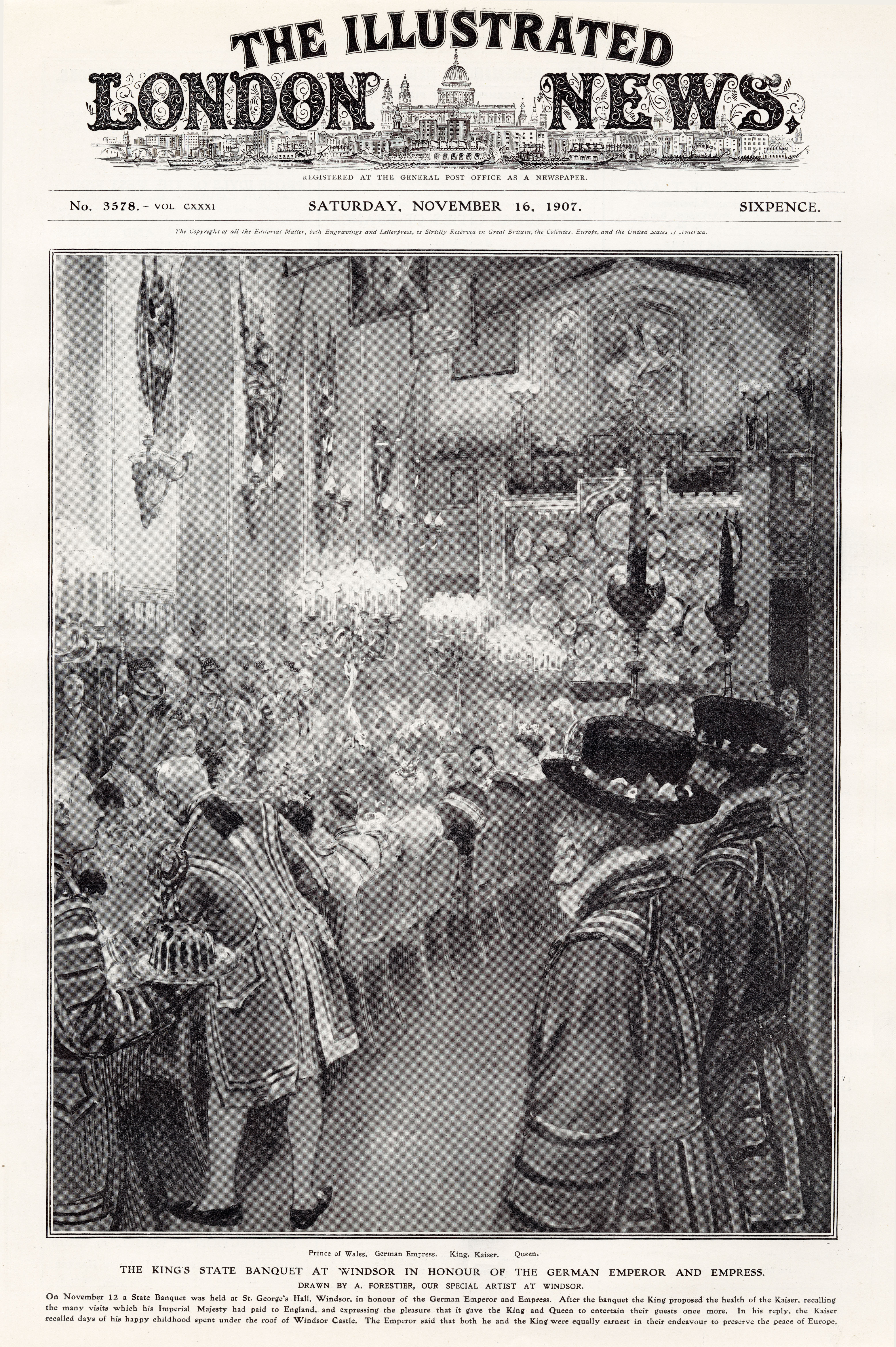
The Illustrated London News depicts the state banquet held in honour of Kaiser Wilhelm II of Germany at Windsor Castle in November 1907. ©Mary Evans Picture Library
Few have been accorded the level of media attention that the 47th President of the United States of America, Donald Trump, received long before he arrived in Windsor on 17 September. Speculation began soon after he took office in January that an invitation would be extended and in February, during a visit to the White House, the Prime Minister, Sir Keir Starmer, with a flourish handed over a personal letter from HM The King inviting the US leader to Britain. The letter, most likely intended for private consumption, was opened by the President and held aloft, giving the attendant press pack the opportunity to photograph and digest the contents. President Trump accepted the invitation there and then.
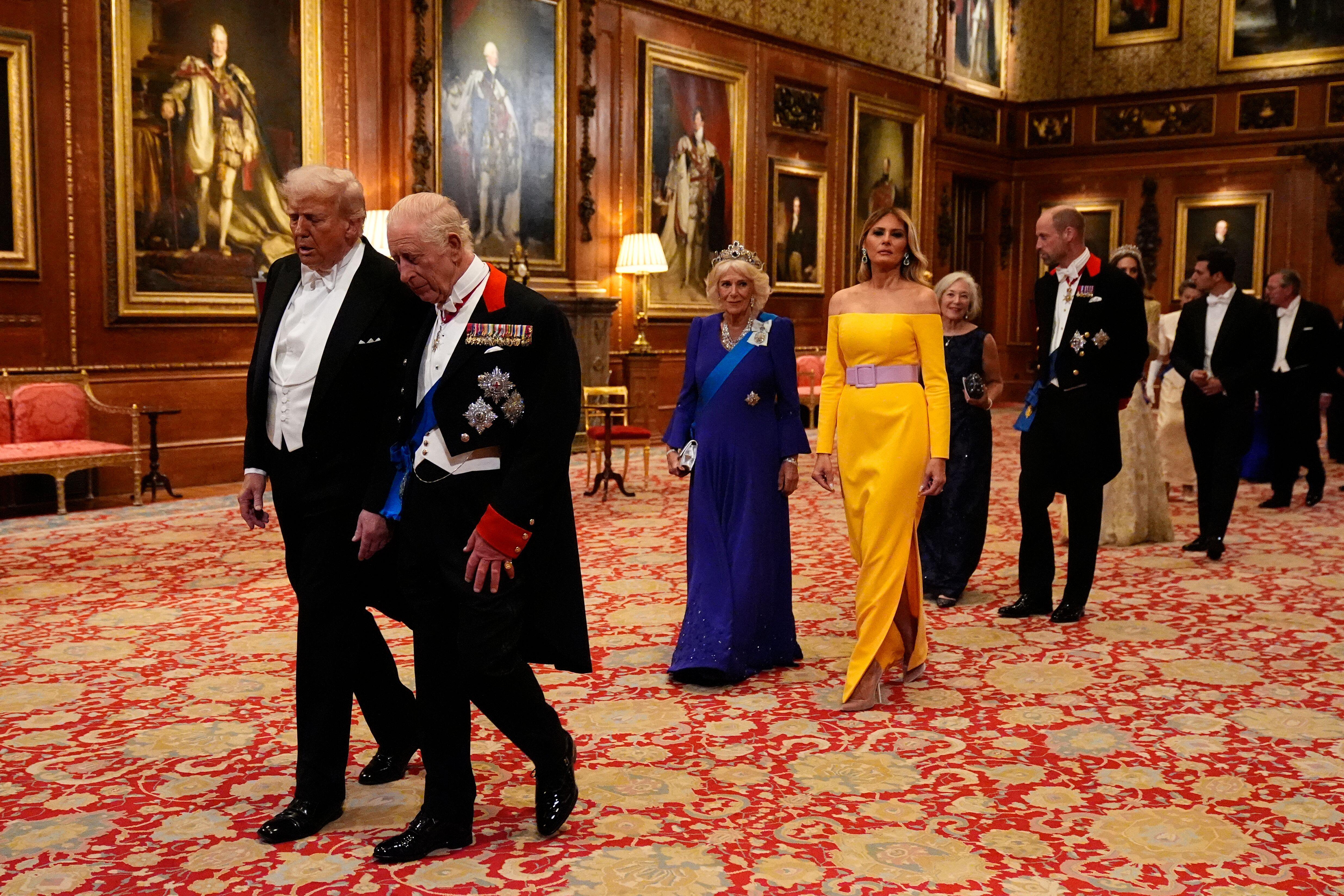
The King and President Trump lead guests to the state banquet at Windsor. ©PA/Alamy.
It was confirmed in June that the Manu Regia – a formal invitation signed by The King – had been hand-delivered to the White House by officials from the British Embassy in Washington. Foreign monarchs and presidents are invited to visit The King on the advice of the Foreign and Commonwealth Development Office and there have now been six inward State Visits since his reign began in 2022: South Africa, Korea, Japan, Qatar, France and the United States. Usually, it’s a one-off during the guest’s reign or term of office, but very occasionally exceptions are made. Queen Margrethe of Denmark, a second cousin once removed of the late Duke of Edinburgh, paid her first State Visit to Britain in 1974, two years after her accession, and 26 years later she was invited again. Likewise, King Olav V of Norway, a first cousin once removed of Queen Elizabeth II, in 1962 (staying at the Palace of Holyroodhouse in Edinburgh) and 1988 (Windsor Castle). Quite remarkably, since his first State Visit was only six years ago, Donald Trump has just become the third member of that exclusive club.
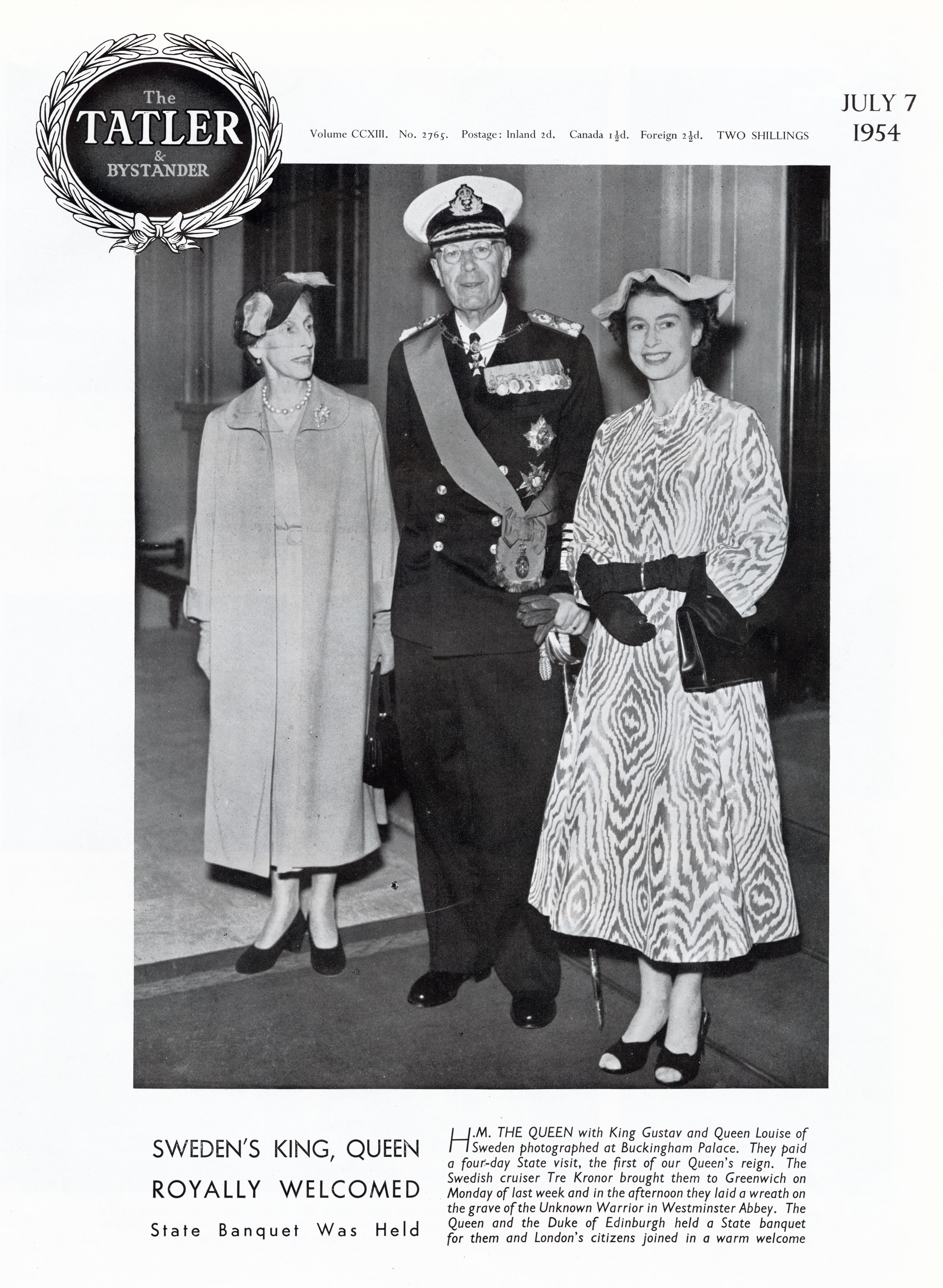
Queen Elizabeth II welcomed King Gustaf VI Adolf and Queen Louise of Sweden for the first State Visit of her reign. ©Illustrated London News Archive.
The first inward State Visit of Queen Elizabeth II’s 70-year reign was that of King Gustaf Adolf and Queen Louise of Sweden in June 1954. Despite the formality of the occasion it was also very much a family affair, given that for Prince Philip it was Aunt Louise – his mother’s younger sister – who had come to stay for a few days. A State Visit template covering four days – Tuesday to Friday – was established in the 1950s and it remained in place until the 1990s, with adjustments made when appropriate to the incoming visitors. Today the duration is shorter: two or three days is the new norm.
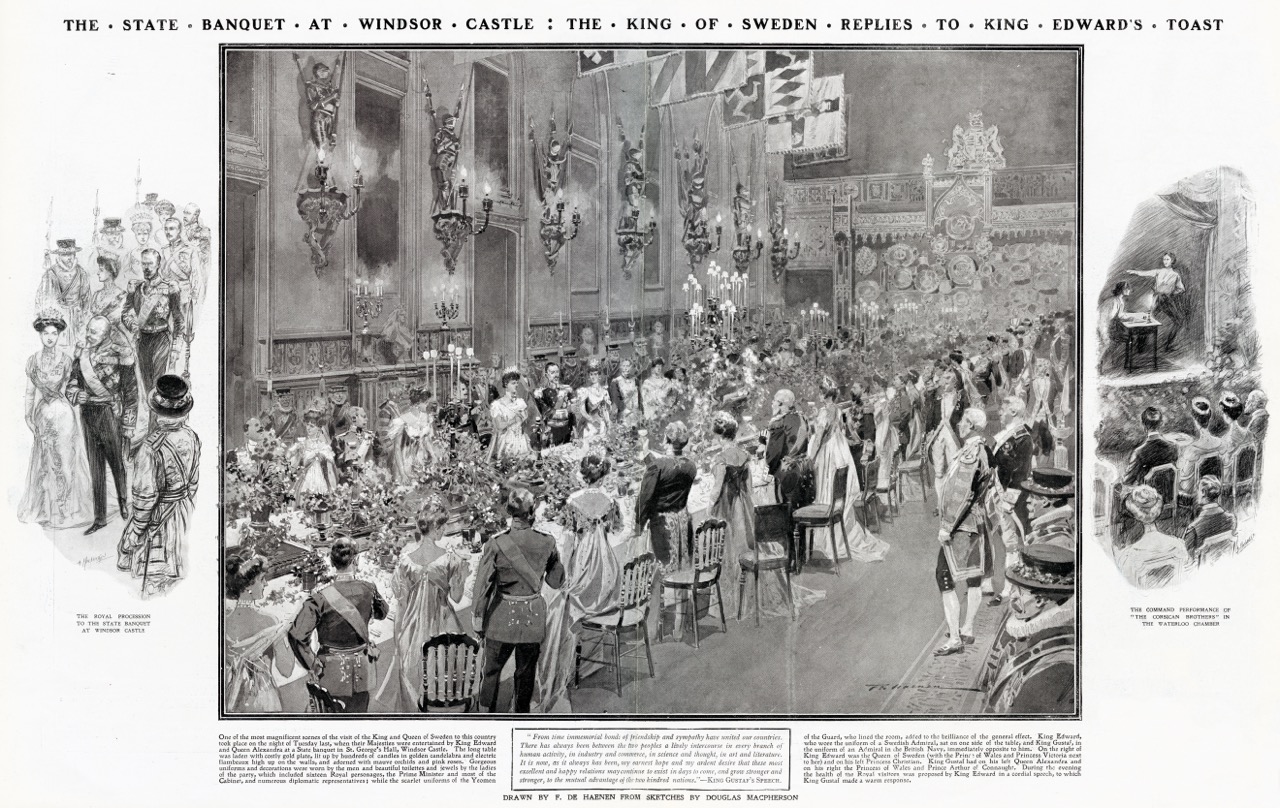
King Gustav V and Queen Victoria of Sweden enjoyed a banquet at Windsor hosted by King Edward VII in 1908. ©Illustrated London News Archive.
Heads of state would arrive at Gatwick Airport to be welcomed by a senior member of the Royal Family – the Duke of Edinburgh, perhaps – and then escorted on to the royal train for the journey to London’s Victoria station, where Queen Elizabeth II and a sizeable House of Windsor contingent were waiting on a red-carpeted, flower-bedecked platform. The handshakes and introductions complete, Her Majesty and her principal guest would walk outside where, weather permitting, the open-top 1902 State Landau was waiting to take them – and mounted soldiers from the Household Cavalry – down characterless Victoria Street, through Parliament Square, up Whitehall and along The Mall to Buckingham Palace, where national anthems were played by a military band as they swept into the quadrangle. Prince Philip and the head of state’s spouse, plus the households in attendance, followed in other carriages.
The impact this had on central London’s lunchtime traffic was considerable, so changes were made in the early 1990s. Since then the VIPs have been driven to Horse Guards Parade, where The Queen, and now The King, greets them at a specially constructed royal pavilion, a guard of honour is inspected and the carriage procession takes the much shorter – and less disruptive – route along The Mall to Buckingham Palace. Gun salutes are fired from The Green Park and at the Tower of London.
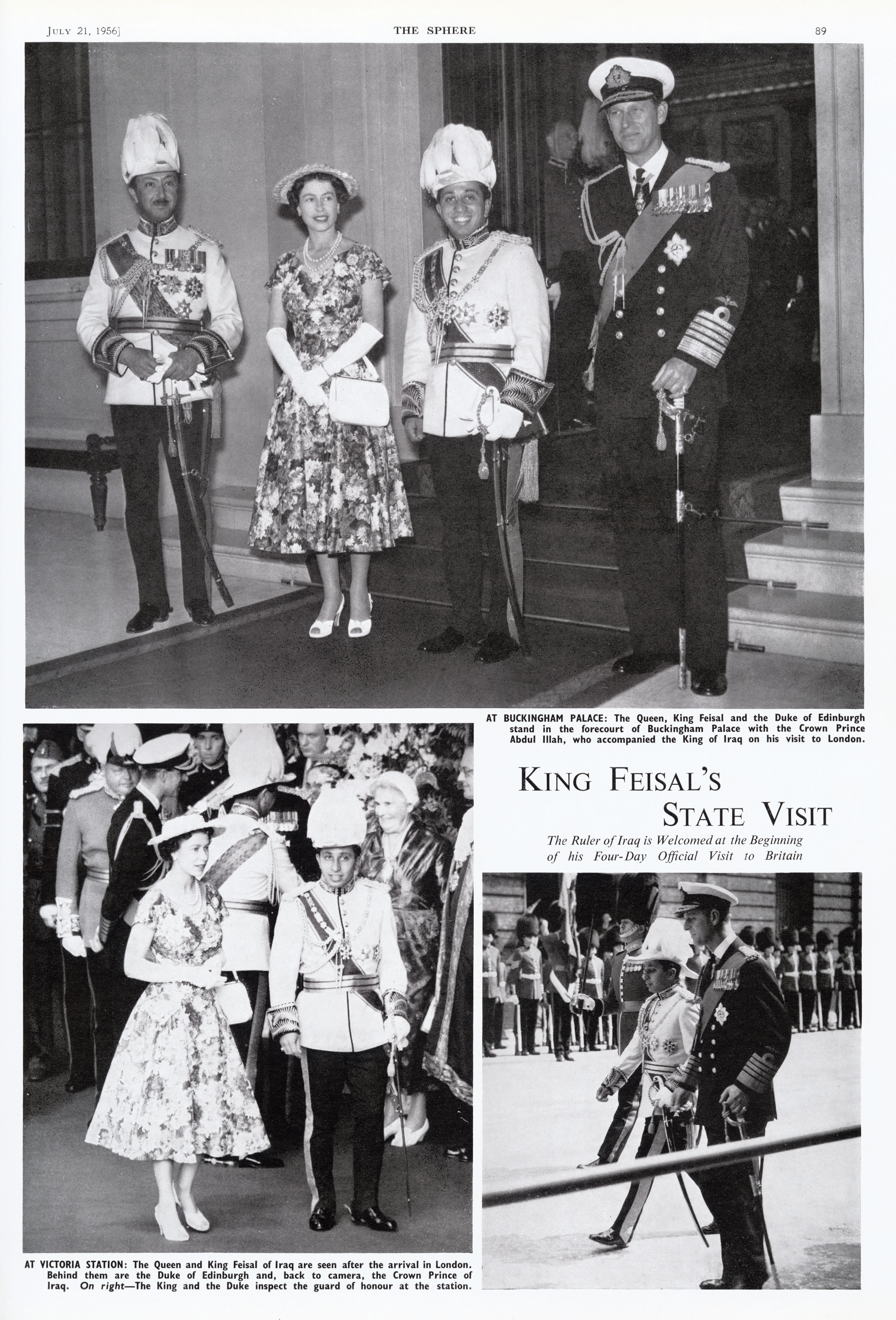
A page from The Sphere picturing King Faisal II of Iraq's State Visit to Britain in July 1956. It was the first such visit to the UK made by an Iraqi monarch, and was one of 113 State Visits hosted by Queen Elizabeth II during her long reign. ©Mary Evans.
A private lunch, usually in the Bow Room, is followed by the viewing in the upstairs Picture Gallery of a display of items from the Royal Collection relating to the country in question. Next on the visitors’ agenda is Westminster Abbey, to lay a wreath at the Grave of the Unknown Warrior, and thence on occasion to the nearby Palace of Westminster to address parliamentarians in the Royal Gallery. On the evening of their arrival, a state banquet is hosted by the monarch in honour of his distinguished visitors. It is a white-tie occasion, with tiaras worn by the royal women, for about 170 guests invited on the basis of their cultural or economic links to the country being hosted. The horseshoe-shaped table in the Palace ballroom – an impressive sight – will have taken several days to prepare, but an abiding memory for guests, particularly first-timers, is the pervading scent of the exquisite floral arrangements.
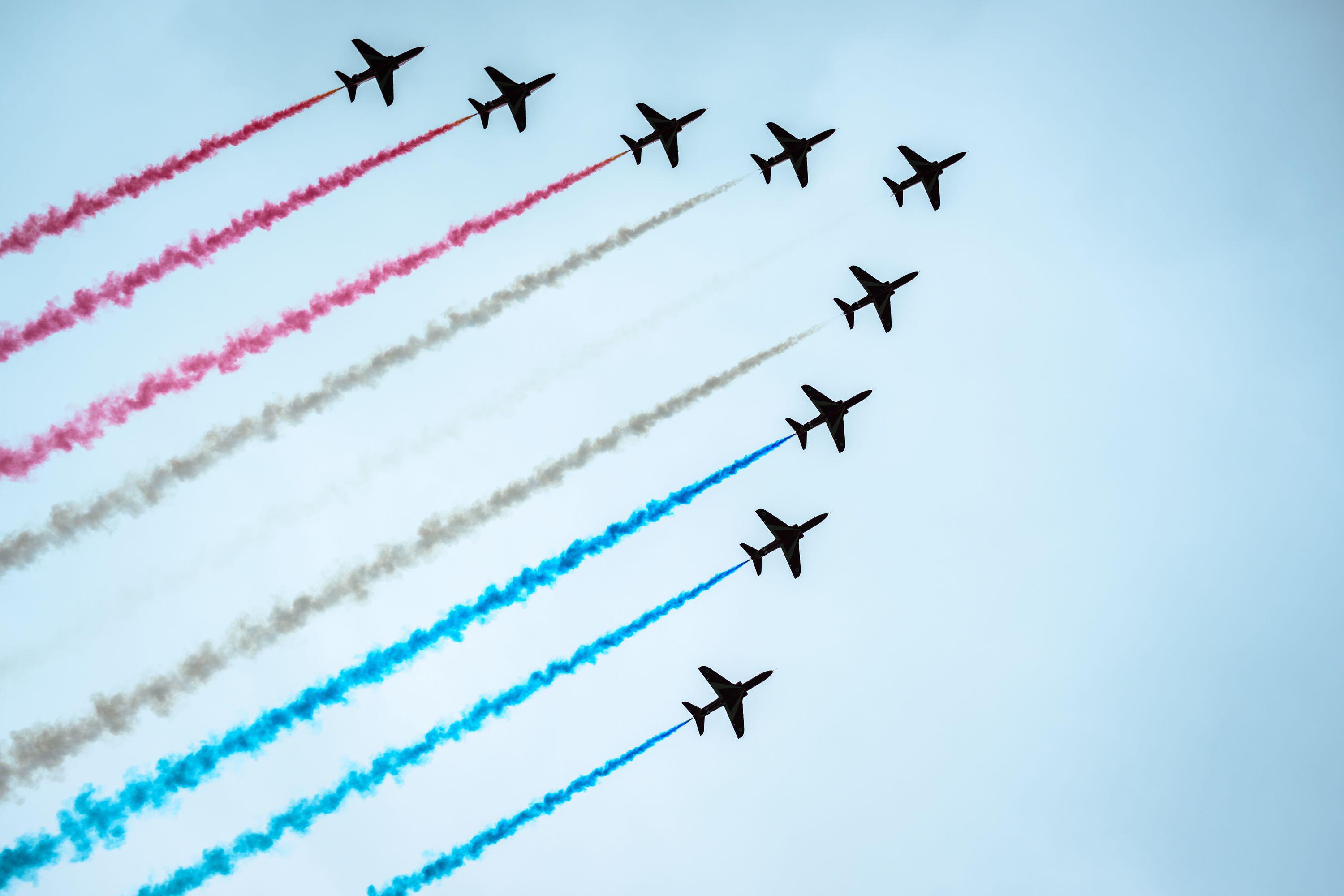
The Red Arrows on display during a State Visit. ©Alamy.
Queen Elizabeth II, accompanied by the Master of the Household, always inspected the table in the early evening before changing into her finery. The tradition continues with The King and Queen Camilla, who make a point of thanking those involved with the production. Before dinner is served, the King makes a speech and proposes a toast to the visiting head of state. He or she replies and ends with a toast to His Majesty.
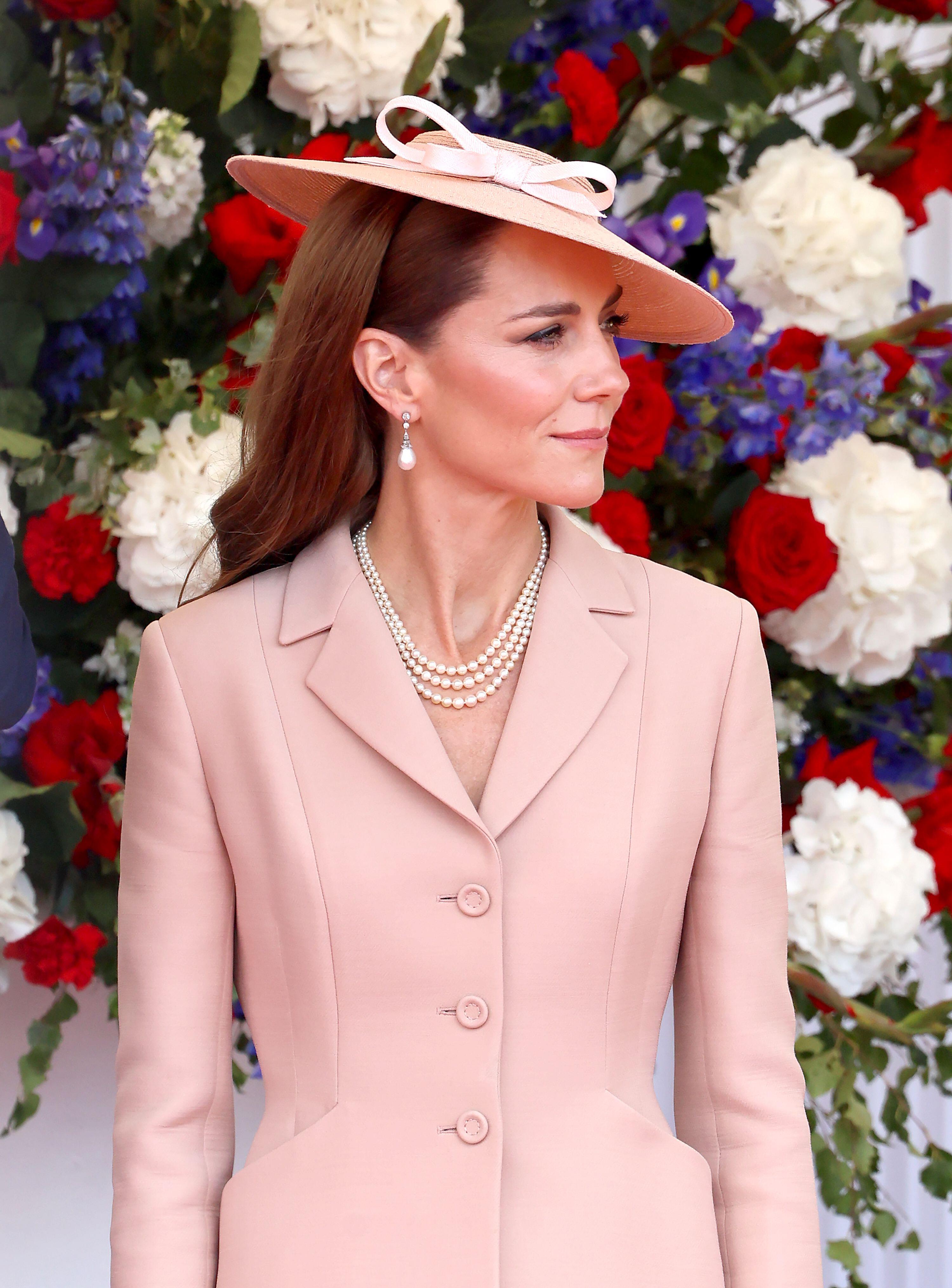
In an expert example of diplomatic dressing, The Princess of Wales wore an ensemble by French couture house Dior to welcome the Macrons. ©PA/Alamy.
Politicians feature prominently in State Visits, not only as attendees at the banquet but also in their own right. No 10 Downing Street is often a destination on day two, as is a banquet given by the Lord Mayor and City of London Corporation at Guildhall, to which leaders of commerce and industry are invited. Until quite late in Queen Elizabeth II’s reign, there were days three and four. This allowed for a trip outside London – Oxford or Cambridge perhaps – and a return banquet, a second white-tie affair, hosted by the state visitor at Claridge’s, the Dorchester or their embassy to thank Her Majesty and family for their hospitality.
Inward State Visits have a revised format these days. Not only are they shorter, but they are also hosted at Windsor Castle because Buckingham Palace, now in the final phases of its £369 million, 10-year restoration project, is unlikely to be fully functioning again until late 2027. So when the President of the French Republic, Emmanuel Macron, and his wife Brigitte arrived for a three-day visit in July they flew into RAF Northolt, in west London, where they were welcomed by The Prince and Princess of Wales. They were formally welcomed by The King and Queen in Windsor and a carriage procession took them through the town centre and up to the castle, where they viewed a military parade and had lunch in the State Dining Room. Afterwards in the Green Drawing Room they were shown Marie Antoinette’s snuff box, a depiction of 15-year-old Louis XIV and an English glass believed to be the earliest champagne glass in existence – presented to George V and Queen Mary from the champagne makers of Reims and Épernay in 1935.
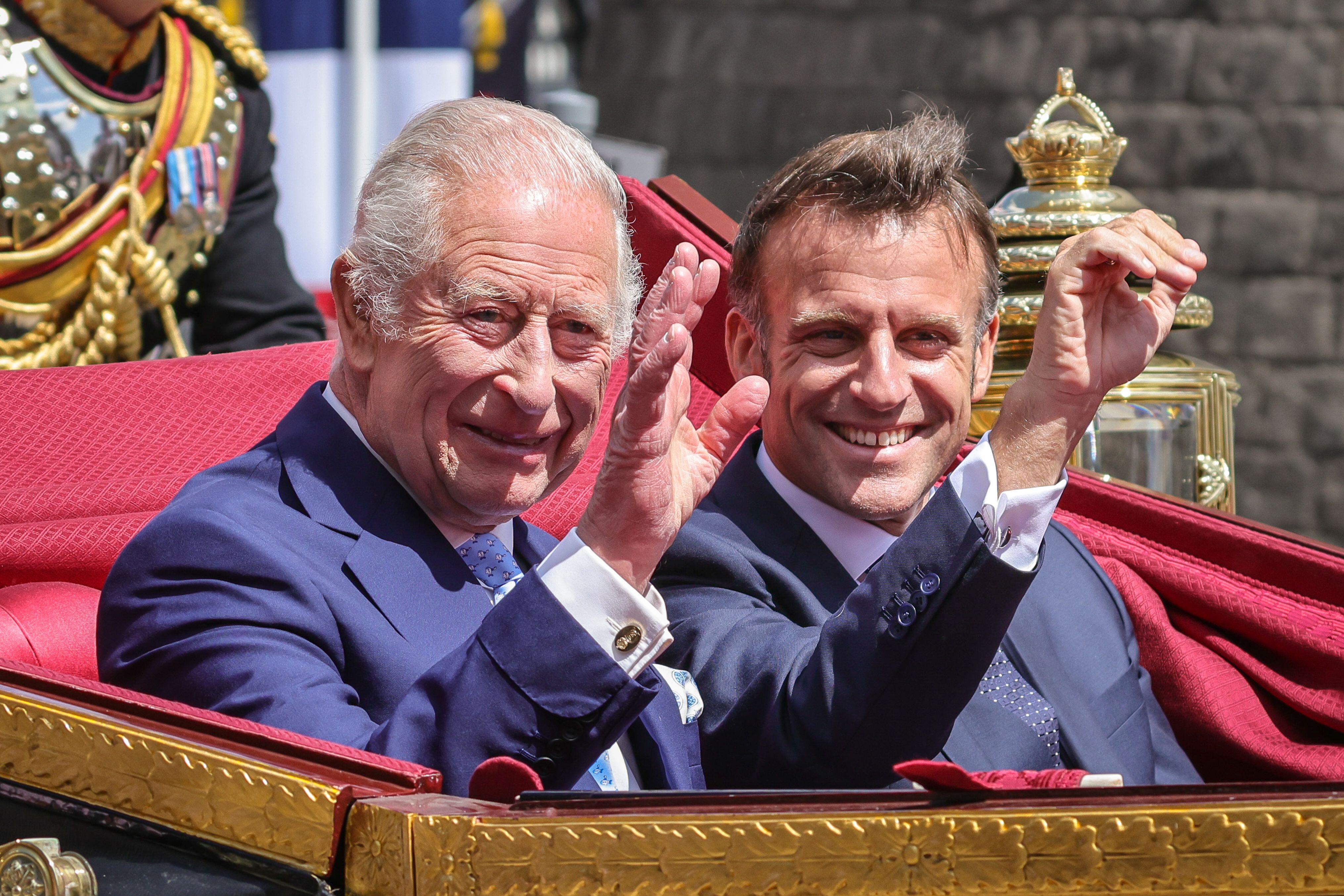
The King and French President Emmanuel Macron wave to the crowds on their way to Windsor Castle in July. ©PA/Alamy.
The Macrons spent the afternoon in London. Back at the castle that evening they attended a state banquet in St George’s Hall in their honour. It had taken almost a week to construct and lay the 160ft table, which was candlelit and decorated with hand-picked and seasonal flowers from the gardens at Buckingham Palace and Windsor Castle, along with flowers and lavender from the Savill Garden in Windsor Great Park, arranged in silver-gilt centrepieces taken from the 4,000-piece Grand Service commissioned by King George IV when Prince of Wales.
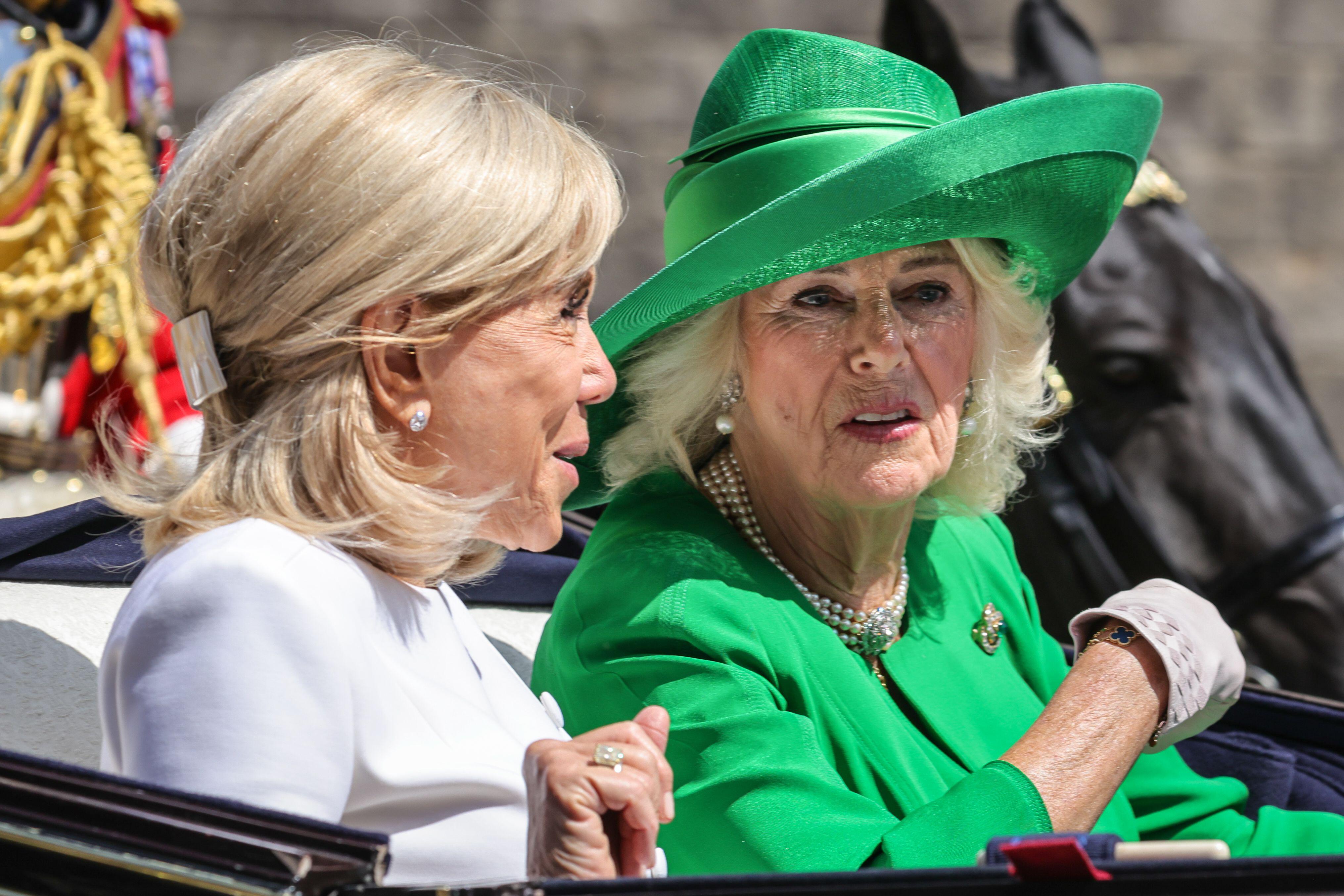
The Queen and French First Lady, Brigitte Macron, during a carriage procession through Windsor in July. ©Imageplotter/Alamy.
French chef Raymond Blanc collaborated with the Royal Household to create the menu, which as always, was approved by The King. Some 160 guests – Sir Mick Jagger and Sir Elton John among them – enjoyed a selection of tender summer vegetables from the gardens of Le Manoir aux Quat’Saisons with sage, tomato and extra virgin olive oil dressing; supreme of Rhug Estate chicken with Norfolk asparagus; and cream of cassis iced blackcurrant parfait on a blackcurrant-soaked sponge with elderflower jelly. Noting in his speech that his guests would be served an English sparkling wine made by a French champagne house, Taittinger, The King said: “As we dine here in this ancient place, redolent with our shared history, allow me to propose a toast to France and our new entente.”
The following morning, the President and Mrs Macron paid a private visit to Queen Elizabeth II’s final resting place in St George’s Chapel to lay flowers on her tomb. After a walk around the castle gardens and saying bonjour to Fabuleu de Maucour, a horse given to Her late Majesty by the President to mark her Platinum Jubilee in 2022, the Macrons took their leave of The King and Queen and returned to London for the remainder of their visit.
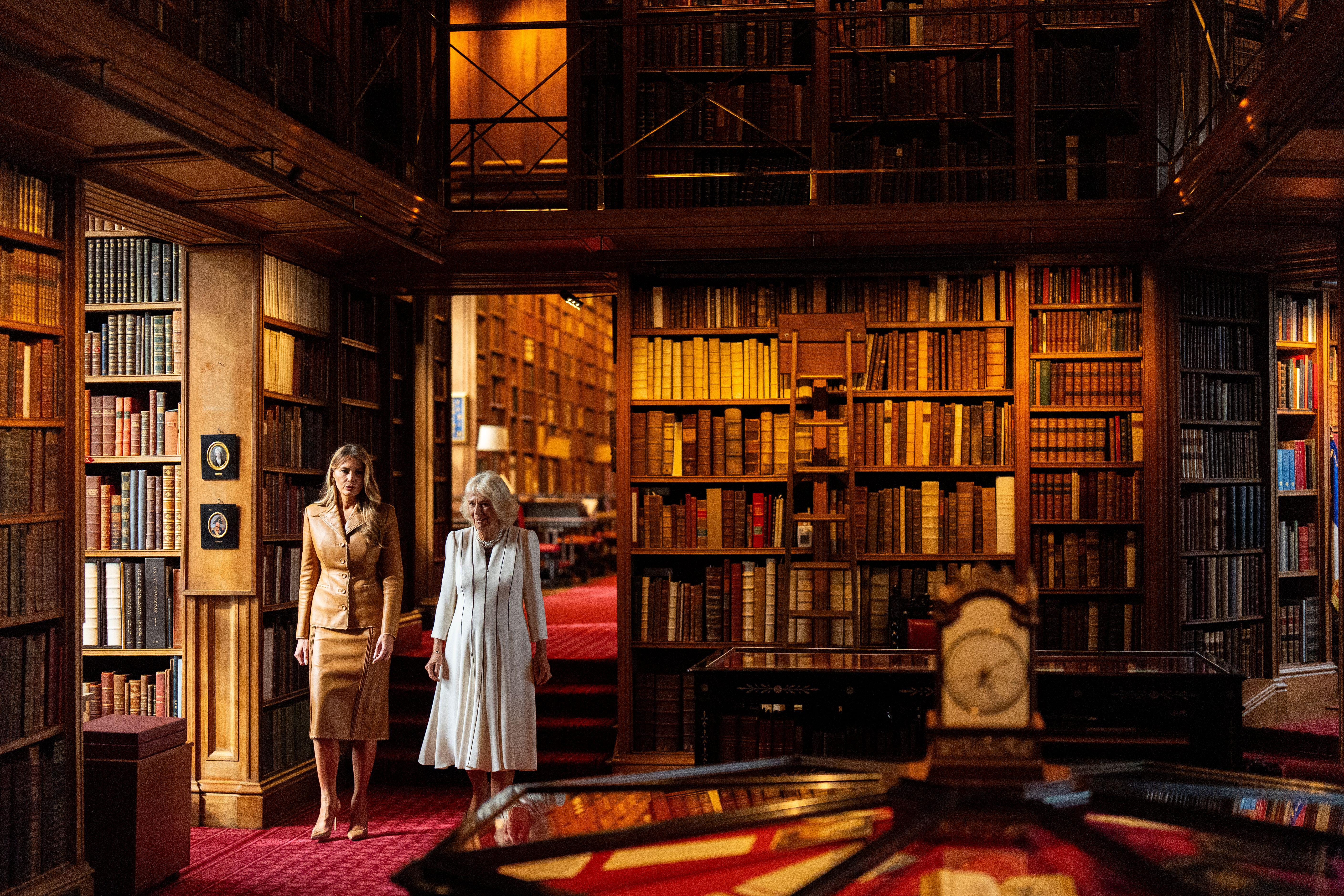
The Queen and First Lady Melania Trump in the Royal Library at Windsor Castle. ©PA/Alamy
The format of President Trump’s second State Visit was similar to President Macron’s in many ways but, unlike his 2019 visit, there were no London engagements. He and First Lady Melania Trump, having landed in the private Home Park at Windsor on the helicopter Marine One, were greeted by The Prince and Princess of Wales, who live nearby, and taken to meet The King and Queen. A carriage procession conveyed hosts and guests through the Windsor estate to the castle proper, with the Household Cavalry Mounted Regiment providing a Sovereign’s Escort for the occasion and members of the Armed Forces lining the unusually bucolic route.
As with the Macrons, there was a guard of honour to inspect, lunch in the State Dining Room with members of the Royal Family, a display of items from the Royal Collection in the Green Drawing Room and a visit to St George’s Chapel, but there was also a Beating Retreat ceremony on the east lawn of the castle that, despite the low clouds, concluded with a flypast by the Red Arrows. A state banquet in honour of the Trumps was held in St George’s Hall that evening where The King and Queen were joined by The Prince and Princess of Wales, The Princess Royal and Vice Admiral Sir Tim Laurence, and The Duke and Duchess of Gloucester for what was a particularly lavish occasion.
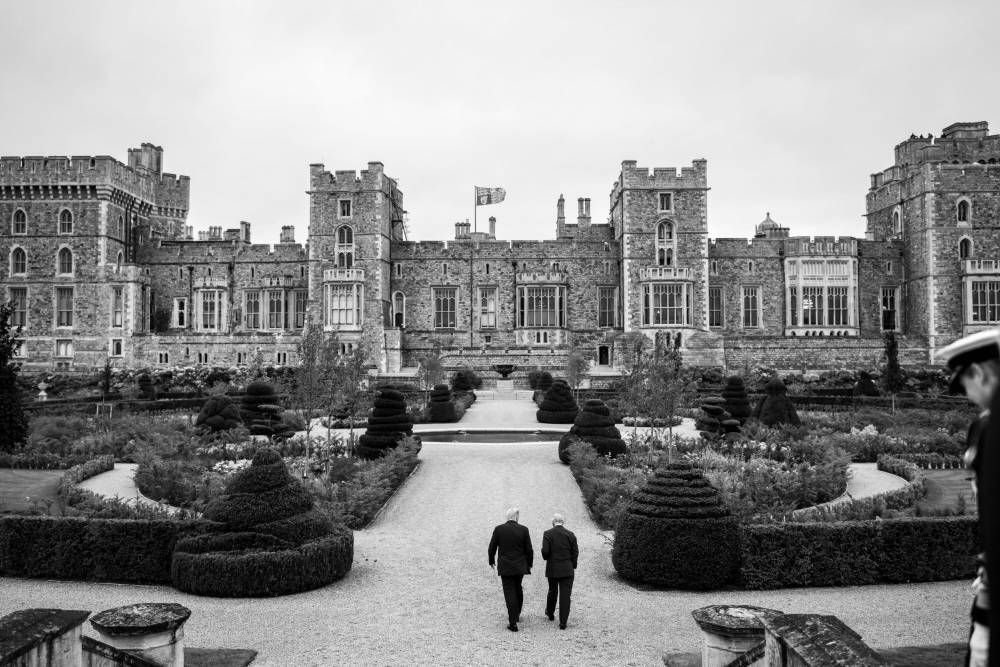
The King and President Trump in the gardens of Windsor Castle during the September State Visit. ©Alamy.
Her Majesty wore an elegant royal blue silk marocain dress by Fiona Clare, which she teamed with the sapphire and diamond tiara made for Queen Elizabeth II in 1963. Catherine dazzled in a stunning hand-embroidered gold Chantilly lace evening coat over a silk crêpe gown by Phillipa Lepley, topped off by the Lover’s Knot Tiara, a firm favourite of the previous Princess of Wales. The First Lady’s striking canary-yellow off-the-shoulder dress from Caroline Herrera was paired with a lavender belt and emerald earrings, a combination that divided opinion among the fashion press, but one which will not be forgotten.
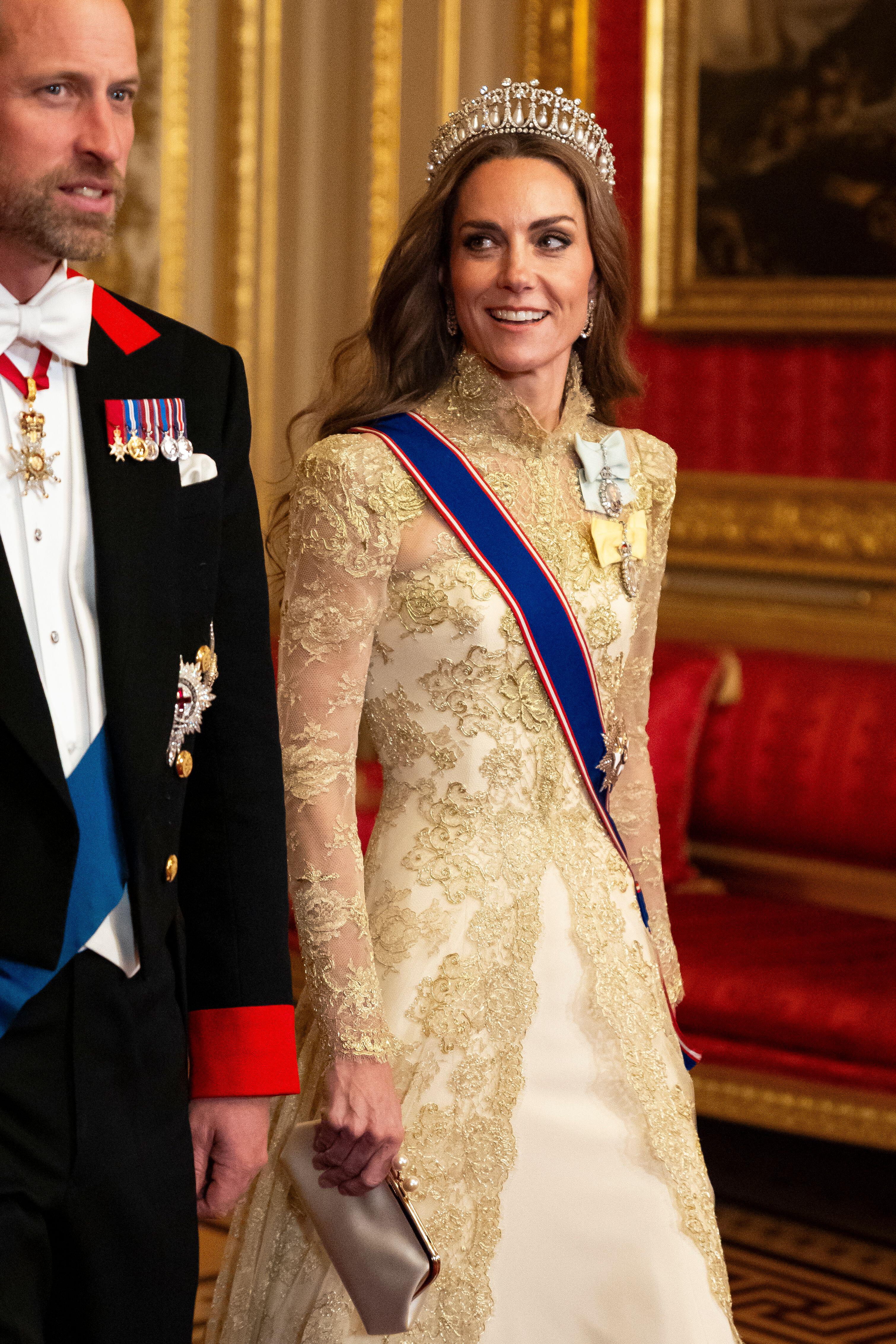
The Princess of Wales wore a hand-embroidered Chantilly lace evening coat over a silk crêpe gown by Phillipa Lepley, with the Lover's Knot Tiara. Prince William was in Windsor Uniform. ©PA/Alamy.
The royal men wore Windsor Uniform – a tailcoat of dark blue cloth with scarlet collar and cuffs – the style of which has evolved since being introduced by George III in the 1770s. Guests were served a menu which, as with the Macrons, exemplified the finest British produce; Hampshire watercress panna cotta with parmesan shortbread and quail egg salad, followed by organic Norfolk chicken ballotine wrapped in courgettes, with a thyme and savoury infused jus. The final course was a mouth-watering vanilla ice cream bombe with Kentish raspberry sorbet interior and lightly poached Victoria plums.
The next morning, The King bade farewell to the President and First Lady, as Mr Trump travelled to Chequers in Buckinghamshire, the Prime Minister’s country retreat, for a meeting with Sir Keir Starmer and a reception hosted by the Chancellor of the Exchequer, Rachel Reeves. Melania Trump, meanwhile, remained at Windsor Castle, where she and The Queen toured Queen Mary’s Dolls’ House and inspected Americana and Old Master drawings in the Royal Library. Afterwards, the First Lady joined The Princess of Wales outside Frogmore House to meet the Chief Scout, Dwayne Fields, and members of the Scouts’ Squirrels programme as they took part in leaf-stamping and bug house-building to achieve their ‘Go Wild’ badge.
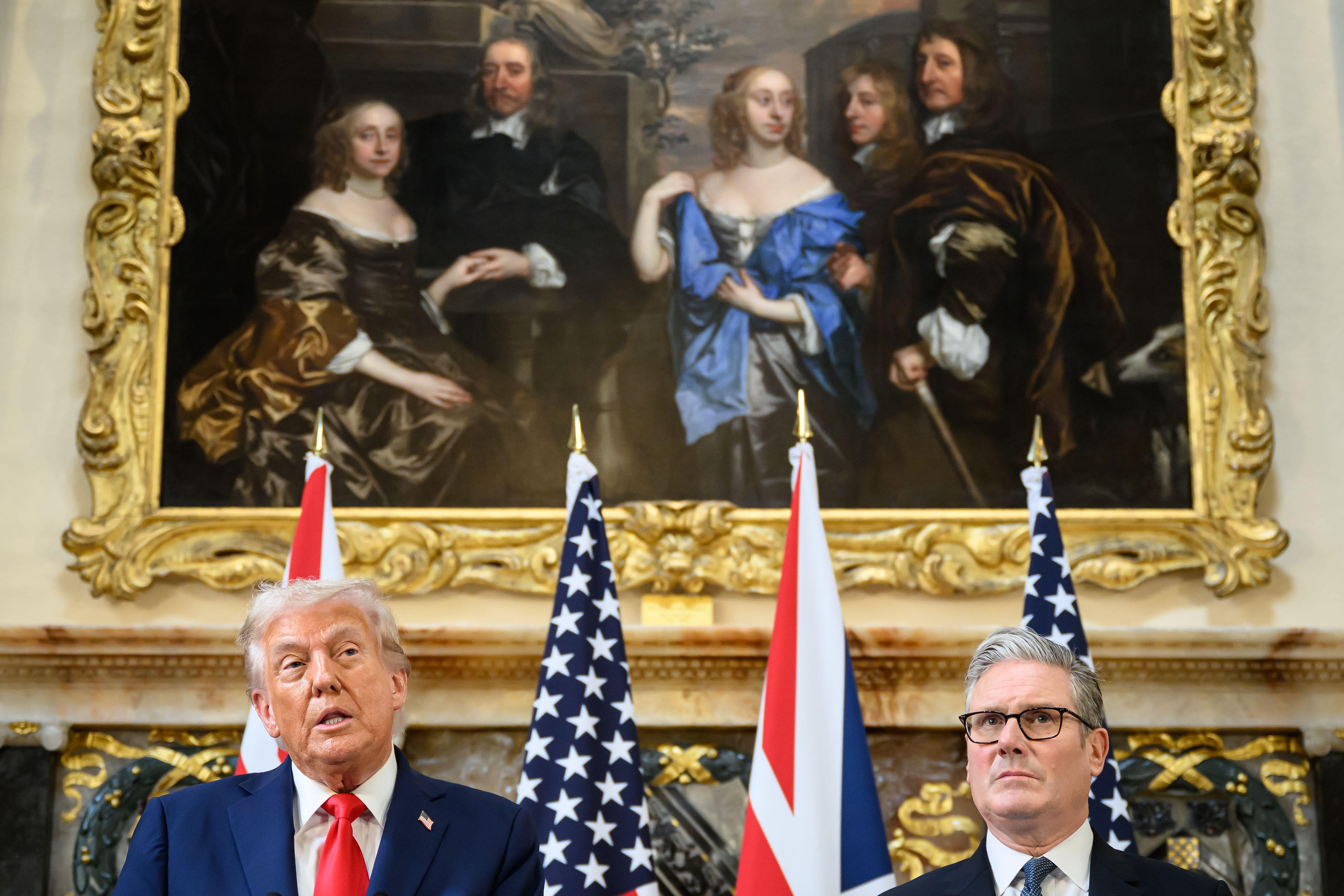
President Trump and the Prime Minister, Sir Keir Starmer, hold a joint press conference at Chequers. ©PA/Alamy.
Mrs Trump travelled to Chequers to meet her husband for the remainder of the day’s programme before the Lord Chamberlain, Lord Benyon, on behalf of The King, bade farewell to them at Stansted Airport that evening. State Visits in the Trump era may have become flying visits, but much of the pomp, ceremony and spectacle remains.