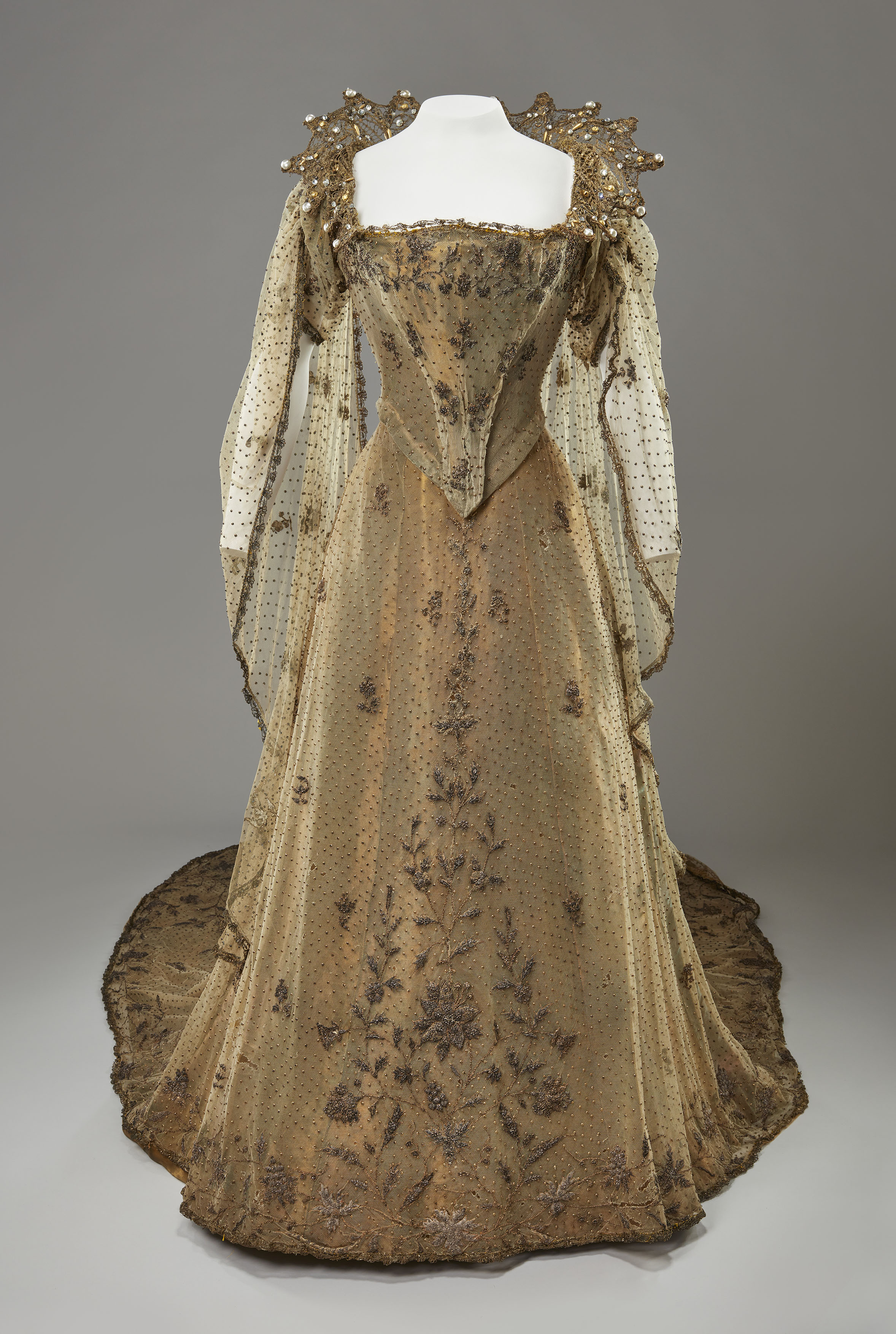
It's been a vintage year for royal fashion headlines, from Zara Tindall in a trouser suit at Royal Ascot to The Princess of Wales donning Dior for July’s state visit by French President Emmanuel Macron. But one outfit has arguably outshone any modern-day rivals, despite the fact it was last worn 123 years ago. When The Edwardians exhibition opened at the King’s Gallery, Buckingham Palace, this spring, the surprise pièce de résistance (for the Royal Collection had cannily omitted any mention of it in pre-show press releases) was the exquisite, glittering gown worn by Queen Alexandra for the 1902 Coronation. A breathtaking, coruscating confection with a ‘faerie queene’ wired collar and spangled netting, over metallic silk, it still has the power to dazzle and beguile. We can only begin to imagine the impact it made when Queen Alexandra stepped out from the shadow of Westminster Abbey’s darkened entrance, to gleam under its newly installed electric lights. Before Kate, before Diana, before Margaret, before all the royal fashionistas we know and love, there was Alexandra, the Danish princess who was the style-setter of her day. Alexandra brought glamour and panache into the Royal Family, and in the process charmed a nation.
How Queen Alexandra Set Edwardian Fashion Trends
17th February 2026
Ahead of London Fashion Week, Lucinda Gosling considers the sartorial choices of Queen Alexandra, the original Edwardian influencer.
This November will mark 100 years since Queen Alexandra died at Sandringham House in Norfolk, a timely moment then to look back at her life, and her style. A Queen-in-waiting for almost 40 years, Alexandra’s story is often reduced to a few familiar themes: her dignified tolerance of her husband Edward VII’s philandering ways, her smothering relationship with her children, the debilitating deafness which saw her retreat from court life, her love of dogs and other animals and, above all, her elegant and apparently ageless appearance.
In the 21st century, we don’t need to look far to find some reminder of her. Most of us will have passed by or lived near an Alexandra Road. There are several hospitals named for her, a legacy of her genuine and heartfelt interest in nursing; and Alexandra Palace in north London was originally going to be the Palace of the People until it was felt a name-change was an appropriate tribute to the much-loved Princess of Wales. Charities, an army regiment, a butterfly and the Queen Alexandra Stakes at Ascot all bear her name.
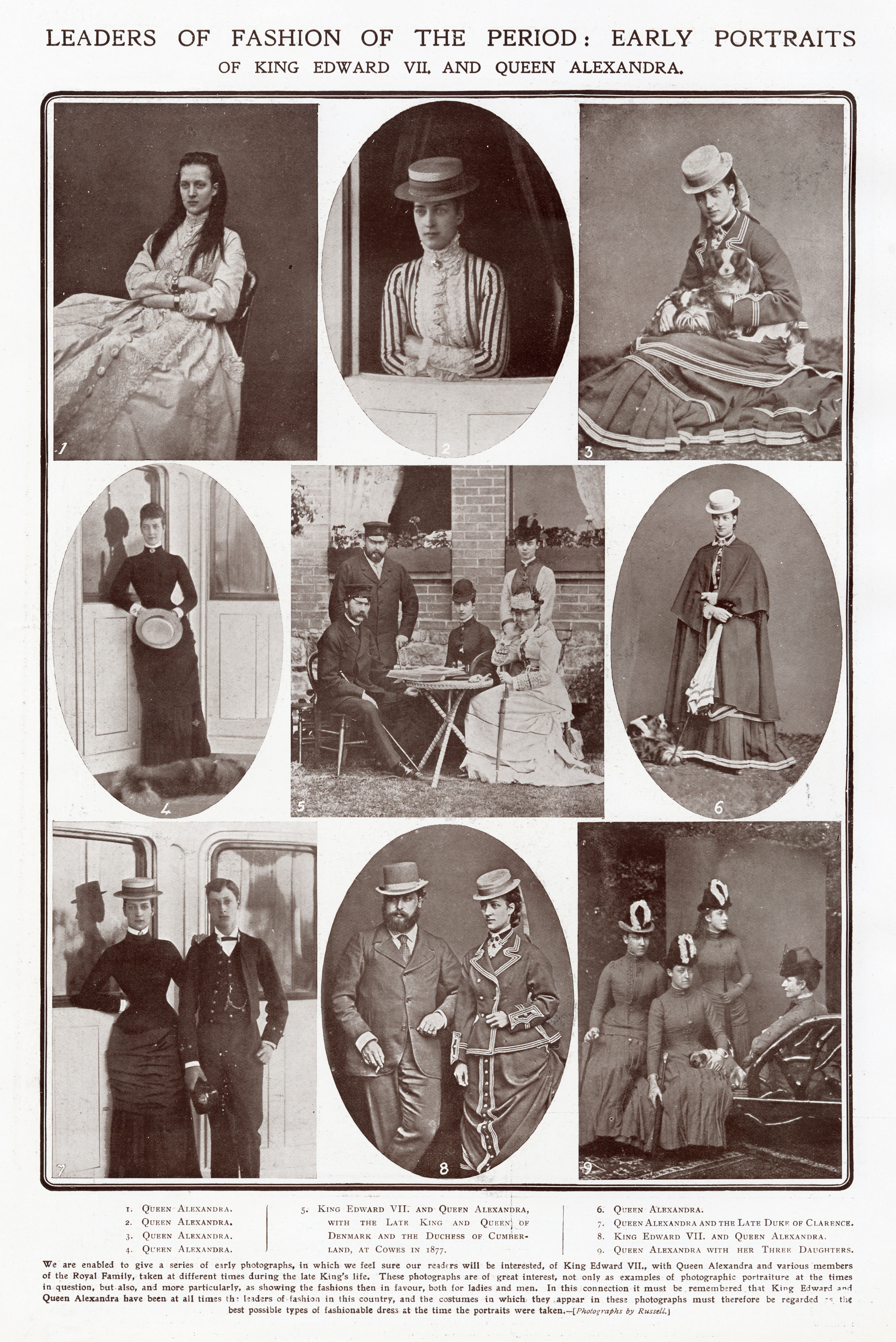
It was regularly commented, often by Queen Victoria herself, that Alexandra was no intellectual. But she was kind, gracious, beautiful and oh-so stylish. Alexandra’s clothes, or rather, her ability to strike just the right sartorial note, were her secret weapon; her superpower if you like. An early biography from 1902, written by Sarah Tooley, described her knack for being impeccably put together: “Tall and graceful and invariably dressed in what appears to be just the right thing for the occasion, devoid of exaggerations of style, The Queen has that easy and reposeful demeanour, which perfect dressing gives."
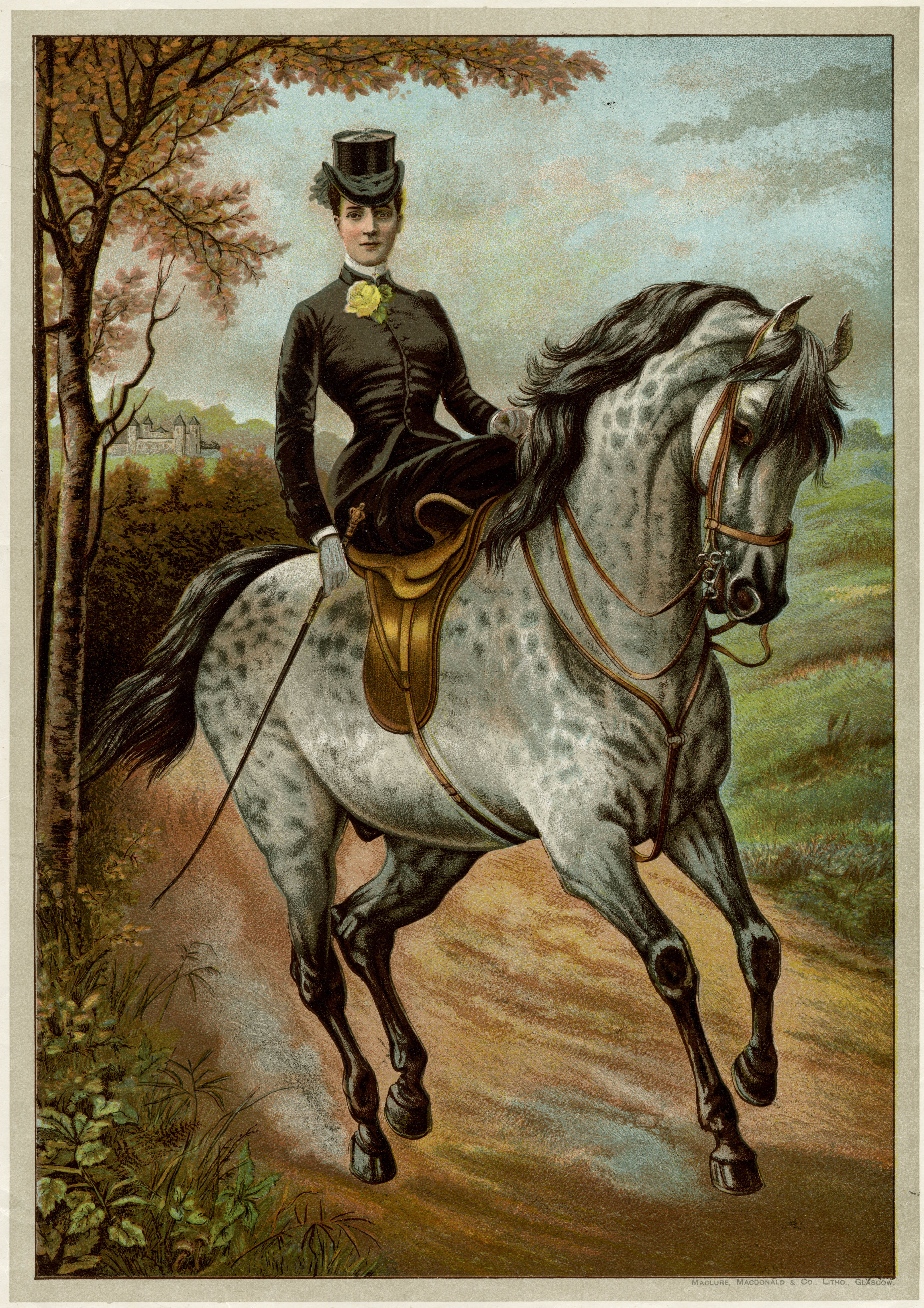
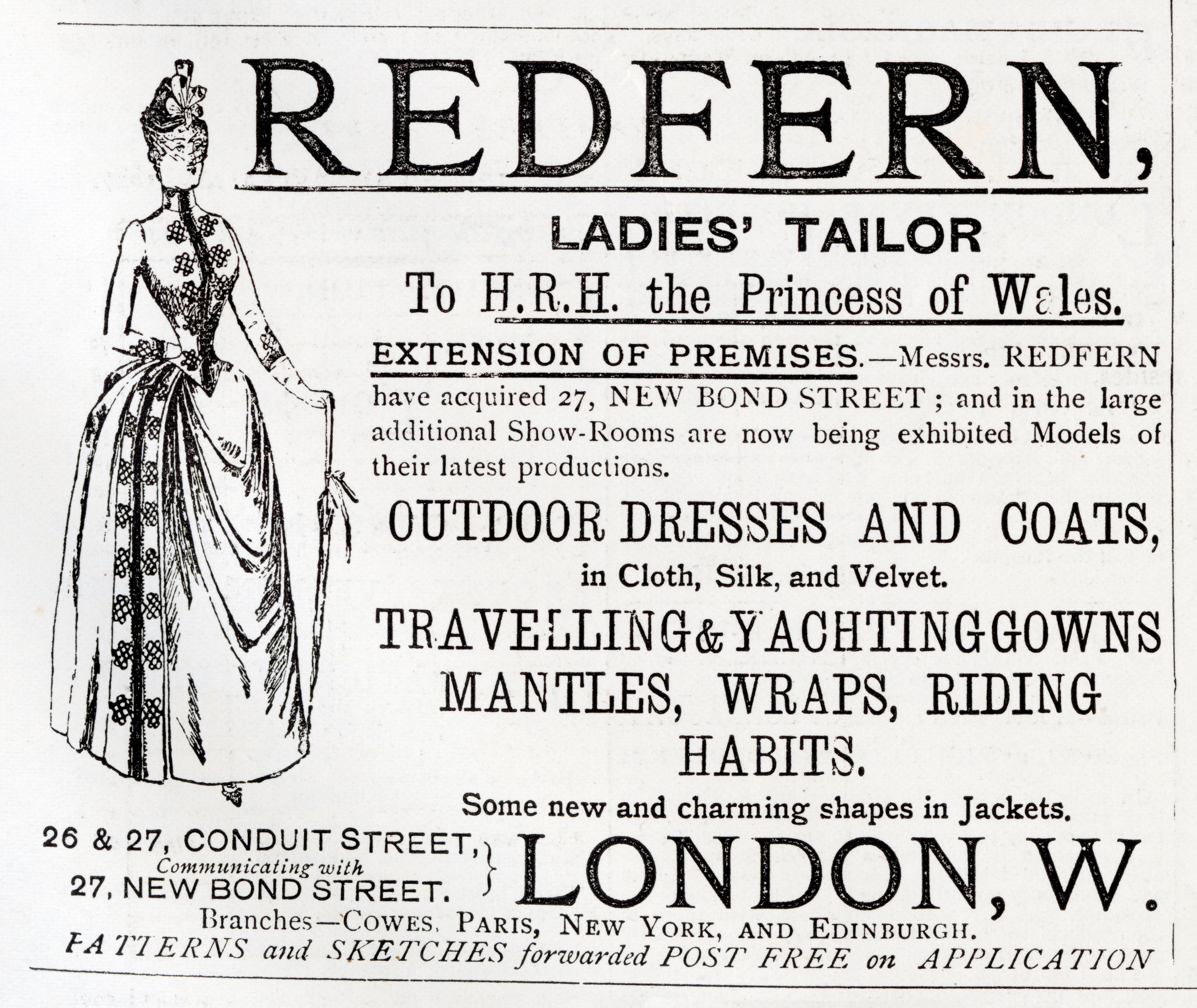
The press took an intense interest in what she wore, devoting column inches to describing the cut, fabric and embellishments of every ensemble, and the British public, starved of a royal pin-up until her arrival, lapped it up. She embraced fashions in a way her mother-in-law Queen Victoria, draped in widow’s weeds, refused to. She followed fashion but was never a slave to it, choosing what suited her – and the occasion. She set trends. Her penchant for the tailor-made, a smart, matching jacket and skirt with its roots in sporting, yachting and riding dress, popularised the look among the wider public and led to the success of tailors such as Henry Poole & Son and Redfern. John Redfern, originally a modest draper based at Cowes (close to Osborne House on the Isle of Wight), found that business boomed when The Prince and Princess of Wales led fashionable society in making Cowes the destination for yachting. The patronage of The Princess (and a Royal Warrant, granted in 1876) was to be the icing on the cake. Further branches in London, Manchester, Edinburgh, Paris and New York followed, establishing Redfern as the premier destination for ladies’ tailoring.
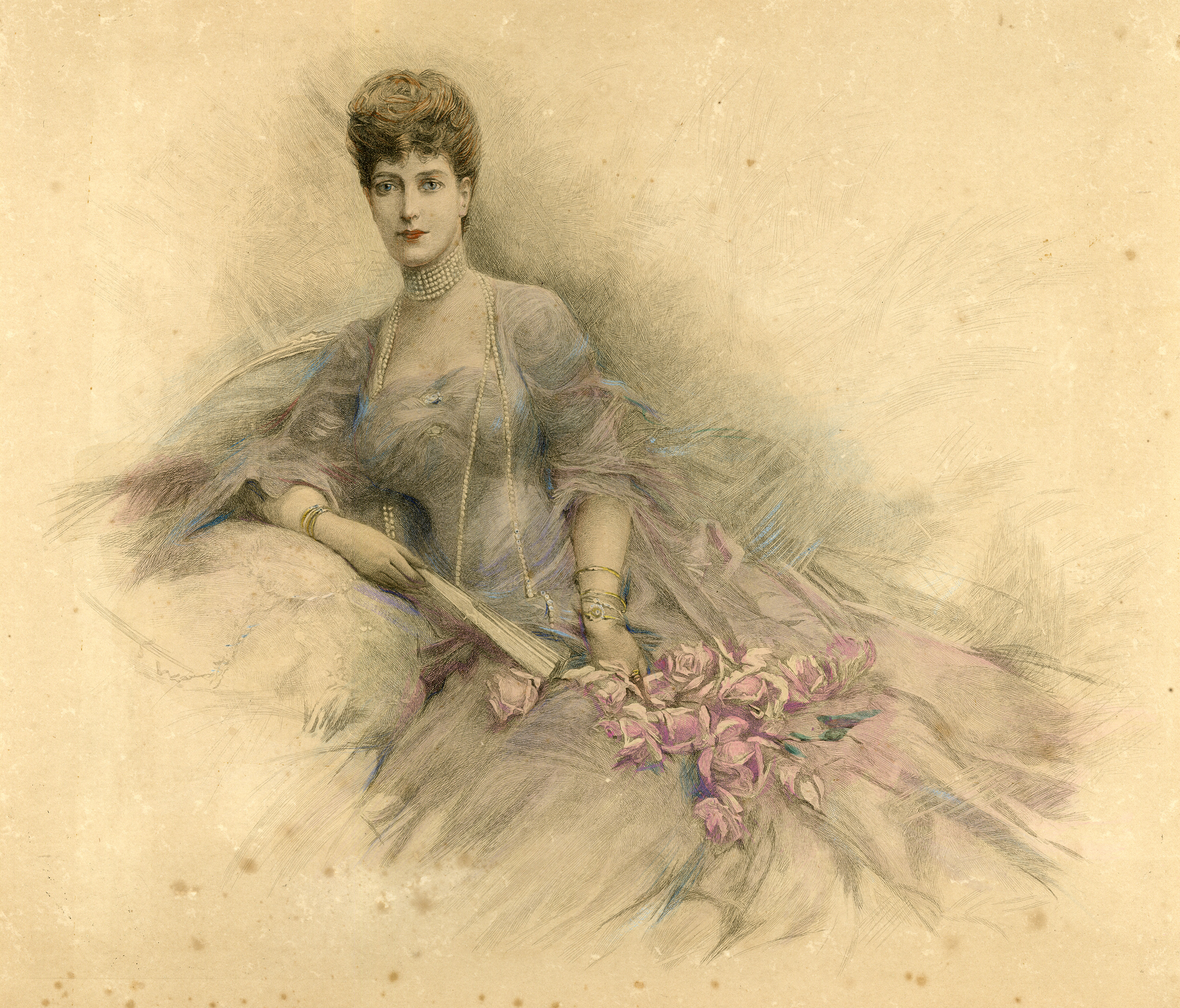
Alexandra famously favoured choker or dog-collar necklaces, allegedly to hide a scar on her swan-like neck; the style would define the Edwardian ‘look’. When the Parisian Diamond Company placed adverts in the press in 1902, it offered, “ropes of pearls to encircle the neck three or four times and then fall to the waist after the splendid fashion that Queen Alexandra patronises”. She was painted by Sir Luke Fildes in 1894, with her Japanese Chin, Punch, in her arms; inevitably the little dogs soon became the height of fashion. And she could turn around the fortunes of an entire industry simply by what she chose to wear; in 1881, her promise to wear only British-produced wool helped reverse the industry’s slump in sales. In short, if Alexandra was alive today, her Instagram would be so hot it would glow.
Princess Alexandra of Denmark arrived in Britain on 7 March 1863, landing at Gravesend just three days before her marriage to Albert Edward, Prince of Wales on the 10th. Her dress, of grey poplin, manufactured appropriately within the British Isles, by William Fry & Co of Dublin, was generally thought to be an unostentatious and thoroughly correct choice for the 18-year-old whose youth and beauty alone charmed the crowds gathered to welcome the Princess to Britain. The colour, silver grey, was known to be a favourite of Queen Victoria. Even as a teenage bride, Alexandra chose her clothes with diplomacy and care. Here was a thoughtful choice which could hardly fail to meet with the approval of her domineering mother-in-law.
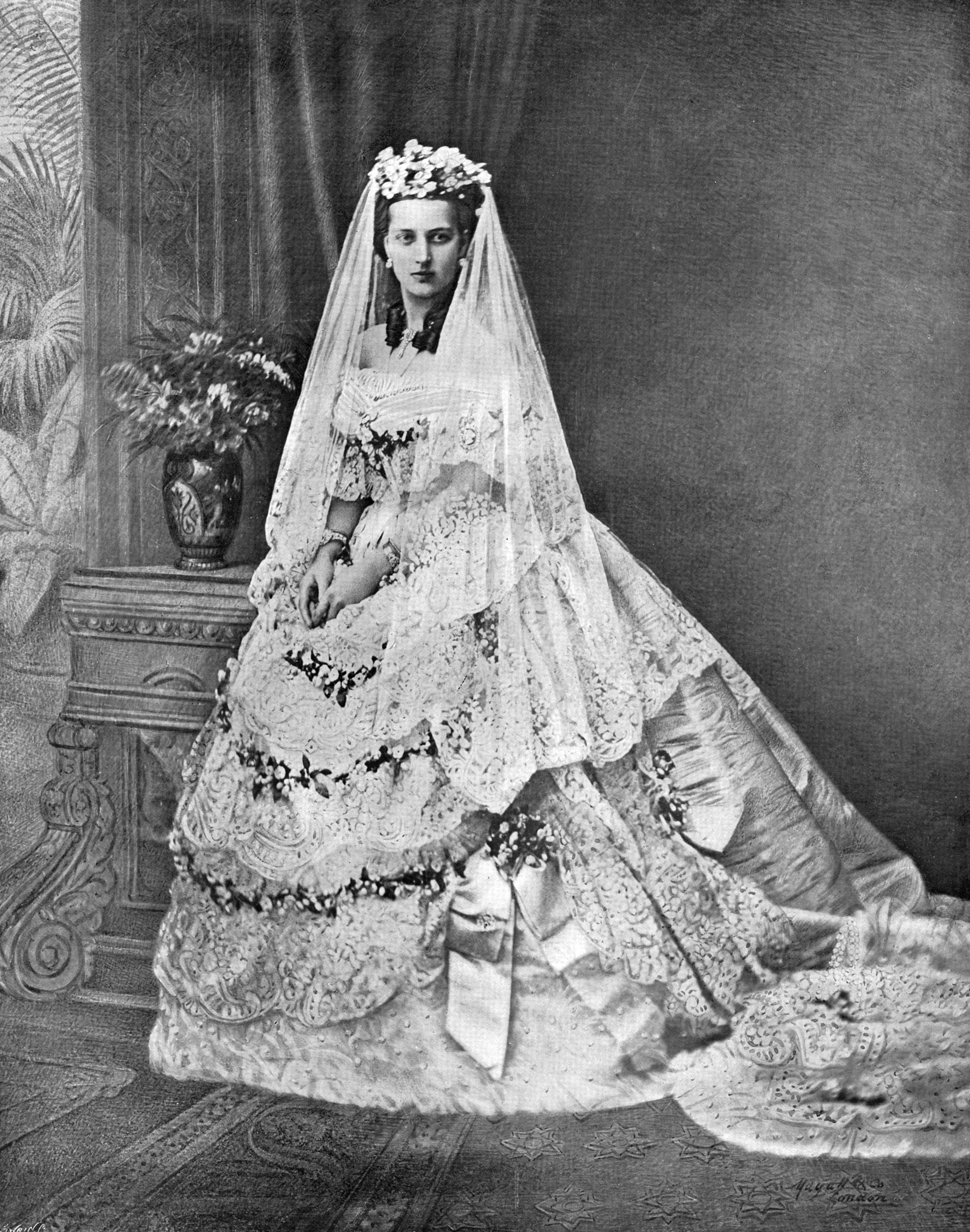
Alexandra also found herself having to yield to Queen Victoria’s wishes on the matter of her wedding gown. Originally, she had been given a glamorous dress of Brussels lace by King Leopold of Belgium, but The Queen made it very clear that the dress for a British royal wedding must be seen to showcase the very best of British craftsmanship. Without fuss, the dress of Belgian lace was substituted for a gown of silver silk tissue designed by the dressmaker Mrs James of Hanover Square, overlaid with four tiers of Honiton lace flounces made by the East Devon firm of Tucker and Son. With Princess Alexandra remaining in Denmark until just days before her marriage, the practical arrangements regarding her trousseau were entrusted to Princess Mary Adelaide of Cambridge (younger cousin of Queen Victoria and the mother of Queen Mary, the future daughter-in-law of Alexandra). Princess Mary Adelaide oversaw the finer details, from the orange blossom that would stud the dress to the lace design incorporating the national symbols of rose, shamrock and thistle.
Everything, bar the Princess’s lingerie (made in Copenhagen), was to be British. Within days of the wedding, Alexandra’s gown had already been altered so that it would be more wearable for the many evening functions she would be obliged to attend as the newly minted Princess of Wales. This hasty recycling particularly frustrated the artist William Powell Frith, who had been commissioned to paint the wedding ceremony in St George’s Chapel at Windsor, and had not reckoned with the bride’s dress disappearing before he had finished his canvas. Alexandra’s wedding dress exists today, in its much-altered state, but intriguingly, in more recent years, a band of Belgian lace has been discovered, stitched into the lining, a secret, but significant indicator perhaps of the young Princess’s independent streak, or at least a tiny concession to her own desires, allowing King Leopold’s gift to remain an invisible part of her wedding trousseau. From the contemporary photographs we can see of the dress, taken by JJE Mayall, it is clear that fashion-forward Alexandra has already begun to move away from the wide crinoline cage style to a skirt with more bulk at the back, a taster of the silhouettes typifying the 1870s. In the early years of her marriage, Alexandra often wore white or cream in public, a shade that eloquently expressed the modesty and simplicity becoming of a young bride.
In 1867, Alexandra gave birth to the couple’s third child – a daughter named Louise. Her confinement coincided with an agonising bout of rheumatic fever, which was to leave her with damaged hearing and a permanently stiff knee. After several months of recuperation, Alexandra was determined not to let her disability affect her and worked on improving her mobility, but her new gait led to one of the most bizarre cases of copycat trends. In a clumsy show of solidarity with the Princess, fashionable ladies began to imitate the ‘Alexandra limp’ and adopt jewelled walking canes for their daily perambulations. Shoemakers even offered pairs of shoes with heels of differing heights to attain the impression of regal lameness. The craze was nationwide; in December 1869, the Dundee Courier newspaper noted with disapproval those adopting it in Edinburgh, arguing it was, “as painful as it is idiotic and ludicrous… no true lady could possibly adopt a fancy which had its origins in the pain and suffering as one so dearly beloved as our future Queen”.
By the 1870s, Alexandra was often seen in richer jewel colours as well as sumptuous velvet. She maintained a simple, statuesque silhouette, aided by her slenderness, and favoured well-cut skirts rather than tight lacing, together with neat hats (each named the Princess robe and Princess hat in her honour). And while she eschewed overly fussy styles, she could be playful with fashion, enjoying the trend for sprays of flowers and other vegetation on her gowns. For a state visit to Ireland in 1885, it was reported in the newspapers that Alexandra wore a dress of green velvet draped with Irish lace, fastened with a bouquet of shamrock and lily of the valley, a marriage of style and diplomacy in dress form, guaranteed to please her Irish hosts.
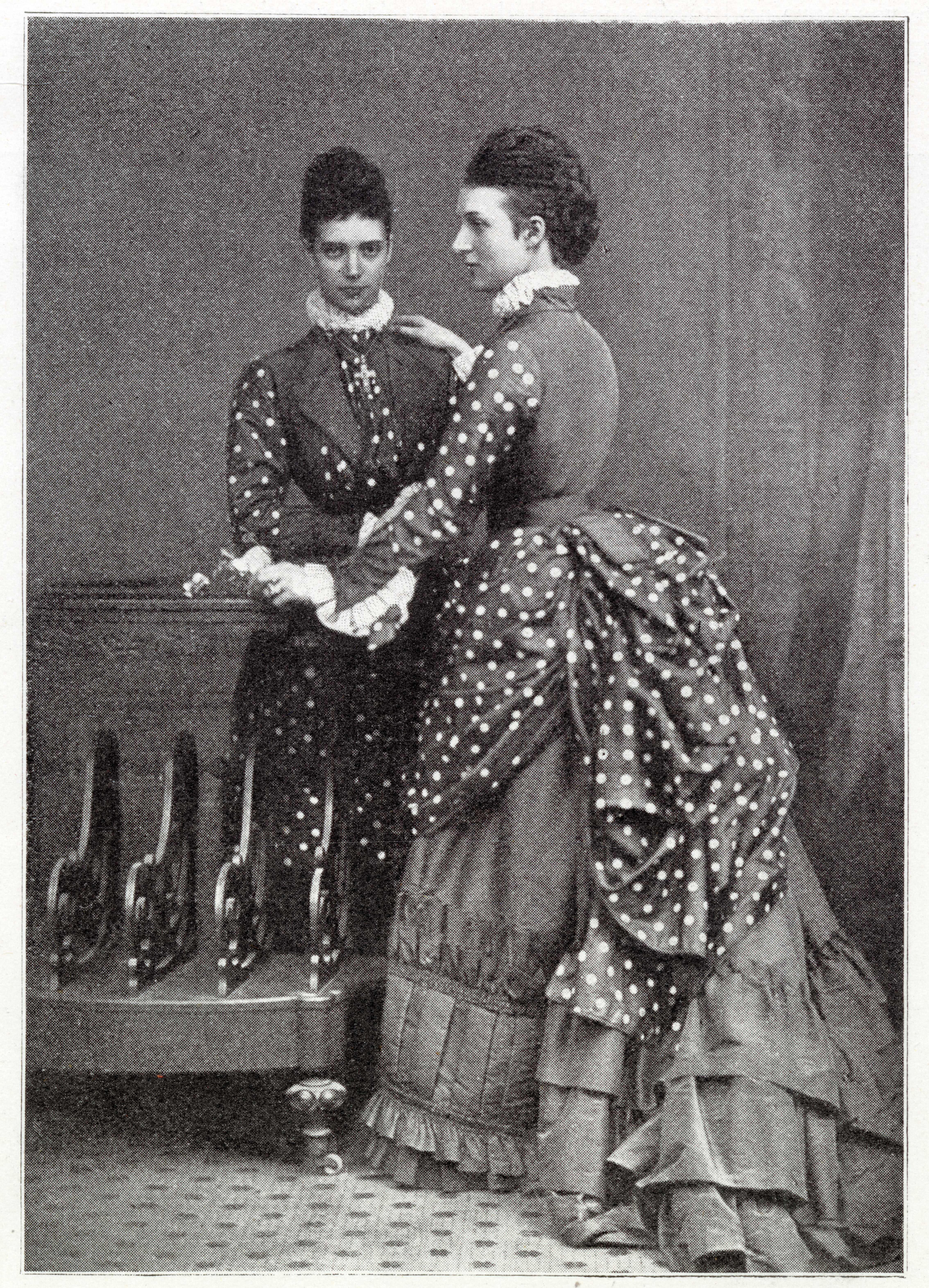
Her sister, Dagmar, wife of the future Tsar Alexander III, paid a visit to Britain in 1873 with her husband. The sisters planned what they would wear in advance, ordering outfits from Worth in Paris, that matched or complemented each other. One day, they wore identical dresses with Dagmar in pink and Alexandra in pale blue, while one photograph from this visit shows the sisters together in matching polka-dot dresses. It was not uncommon for siblings to dress alike during this period, but the adoption of the ‘twinning’ trend by The Princess of Wales and the future Empress of Russia, and its dissemination via thousands of cartes de visite, caused quite the sensation.
An unexpected tragedy marked Alexandra’s middle age when her eldest son, Prince Albert Victor (‘Eddy’), Duke of Clarence, died of pneumonia in January 1892, aged just 28. Afterwards, the colour palette she chose for her clothes took on a softer, more sombre tone, with purple, pale mauve, silver and cream alongside the traditional black mourning. When she became Queen in 1901, her wardrobe began to reflect her elevated status with dense embroidery, spangles, beadwork and metallic thread all adding to her appearance of majesty. Her coronation gown was a prime example of Alexandra at the peak of her fashionable powers.
With nobody to answer to except herself, she chose a French house, Morin-Blossier, to design her dress, convinced of the superiority of French dressmakers when it came to evening wear, and took elements from costumes she had worn for fancy-dress balls, confident that a note of theatricality was what was needed for the occasion. The gold fabric she had woven in India at the Delhi firm Manick Chand, under the watchful eye of Mary, Lady Curzon, the stylish young Vicereine, who was sworn to secrecy over the details. Back in 1869, Alexandra had been bitterly disappointed when she was forbidden by Queen Victoria from accompanying her husband on a visit to India and as a consequence retained a romantic hankering for the country. The fabric of her coronation gown at least connected her to India a tangible way. Not only that, with the gold cloth being woven thousands of miles away, the gown could remain under wraps until the big reveal. Alexandra had expressly wished that none of the ‘London ladies’ would get wind of her design and attempt to copy it. She intended to look the part and celebrate her queenly otherness.
In the 15 years following the death of her husband, old age began to erode her famous beauty, although the press and public alike continued to subscribe to the belief that The widowed Queen was eternally youthful. Photographs were doctored to erase lines and sagging, and when out in public, Alexandra often wore a veil. It was smoke and mirrors – she was only human – but everyone seemed to want to believe that age could not wither her. In the lengthy tributes to her following her death on 20 November 1925, just 11 days before her 81st birthday, one notable feature was a spread of photographs in The Illustrated London News documenting her position as a “leader of fashion” over the years. The article commented that when Alexandra became a grandmother in the 1890s, Queen Victoria would have preferred her to adopt a more matronly style of dress, but Alexandra “saw no reason to clothe her still erect and graceful figure in an elderly way”. If you’ve got it, flaunt it, and Alexandra certainly did, as long as she could, and all in the best possible taste.
To find out more about this glamorous era, visit The Edwardians: Age of Elegance at The King’s Gallery, Palace of Holyroodhouse. The exhibition runs from 24 April – 6 December 2026 rct.uk